Fellow fishing enthusiasts, whether you're chasing after Pike in the vast lakes of North America or challenging giant saltwater species along the Australian coast, the choice of your fishing lure is always critical to your success. When exactly should you use a heavy lure? And when is a light lure the better choice? This decision goes beyond simple casting distance—it’s about having a "conversation" with the fish. As an experienced angler, today we’re diving into this core topic to help you gear up and prepare to conquer fishing spots worldwide!
Say Goodbye to Blind Casting: The 'Secret' of Lure Weight and Casting Distance
Many people assume that the heavier the lure, the further it can be cast. This idea is only half right. While weight is the foundation of casting distance, it certainly does not mean that distance increases indefinitely with weight. This often involves the lure type and its center of gravity (CoG) design. For instance, a 10-gram Suspending Minnow might have its CoG closer to the middle, whereas an 8-gram Spoon will clearly outperform the minnow when it comes to long-distance casting.
CoG Design: Why Can Light Lures Still Be Cast Far?
For lures of the same type and weight, the one with a smaller volume and a more rearward center of gravity will cast further. A smaller volume means less air resistance; a rearward CoG provides strong wind-breaking ability and stability during flight, preventing tumbling. This factor is crucial for searching large bodies of water.
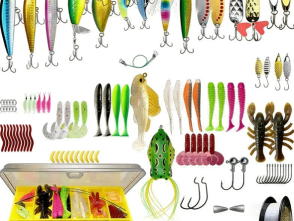
Practical Tip: If we need to cover a large search area—say, chasing high-speed fish—we can prioritize lures like Jigs, Spoons, VIBs, and Sinking Pencils. These typically help us cover greater distances and significantly improve search efficiency. However, if you are fishing in a narrow river channel, such as for trout in a European stream, and a Minnow can already reach the far bank, there is absolutely no need to choose a long-casting jig. Lures like spoons, VIBs, and Jig Heads will suffice.
The Golden Rule: Choosing the 'Right' Weight Based on Depth and Current
Use heavy lures for deep water, and light lures for shallow water; use heavy lures for fast currents, and light lures for slow currents. This principle mainly applies to sinking type lures.
Heavy Lures in Deep Water, Light Lures in Shallow Water: Common Field Mistakes
When arriving at an unfamiliar body of water without knowing the depth, we can first select a VIB, Spoon, or Jig Head to "probe" the depth. Cast the lure out and feel the speed at which it drops and hits the bottom.
Mistake Warning: If the lure hits the bottom very quickly, it indicates the water is relatively shallow, and your lure is too heavy. Using a heavy lure in shallow water forces you to retrieve it quickly to maintain its action, which not only often misses bites but also greatly increases the risk of snagging!
Core Technique: The 'Lure Fall Formation'
We usually want the lure to have an adequate "fall formation" during its descent. This formation gives the fish enough time and opportunity to discover and strike it. Conversely, if the water is very deep and the lure is very light, the lure's sinking speed will be extremely slow and the search distance short, which will also severely affect fishing efficiency. Selecting the right lure is crucial. REeffun also has an excellent series of lure products designed for deep water, including various high-density VIBs and Jigs that offer fast bottom exploration.
Fast or Slow Current: Balance Determines the Hook-up Rate
In rivers or flowing water environments (such as many waterways in North America and Europe suitable for pike fishing lures), our goal is to allow the lure to drift with the current while still being able to hit the bottom or stay in the target water column.
Operational Principle: Achieve a "balance" in lure weight. If the lure slams straight into the bottom after casting, the lure is too heavy. If you retrieve the lure and it drifts with the current but never reaches the bottom, or is quickly pushed to the bank, the lure is too light. The core lies in allowing the lure to drift with the current while still gently touching the bottom, mimicking a natural movement that signals easy prey to the fish.
Reading the Fish: The Lure Weight Philosophy for Pressure Spots and High-Activity Waters
What we've shared so far covers choices under normal conditions. However, all fishing activities depend on the state of the fish, so we must also adjust based on their activity level.
Handling Pressure Spots: For example, a body of water where many anglers fish daily is called a "pressure spot." The fish there are usually cautious. Even for fish in deep water, we will try to use light lures (sometimes lighter than standard) to lower the fish's wariness, or use light lures for slow enticement when fish activity is low due to low barometric pressure.
Handling High Activity: If you encounter highly active fish with strong aggression (for instance, saltwater fishing lures being chased on the surface), then we would choose a slightly heavier lure with a larger action to match the frenzy, which can significantly increase our hook-up efficiency.
Gear Upgrade: Lure Weight Suggestions for Different International Fish Species
Targeting North American Freshwater Giants: pike fishing lures and walleye fishing lures
In North America, Pike and Walleye are major targets for lure fishing enthusiasts. Pike often prefer attacking larger targets but frequently hide in weeds and shallow edges, requiring a balance between weight and anti-snag performance. Spoons or VIBs weighing 1/2 oz (approx. 14g) to 1 oz (approx. 28g) are very versatile. For Walleye, which are more active at night or in deep water, using a 1/4 oz (approx. 7g) jig head paired with a soft plastic can effectively hit the bottom and specifically entice them.
Conquering Global Coasts: Weight Selection for saltwater fishing lures
Saltwater environments feature massive variations in water depth and current. Light lures (e.g., 10-20g) are suitable for estuaries and surf fishing, typically floating or shallow-diving minnows. For boat fishing or shore casting, especially when targeting powerful species like GT (Giant Trevally) that require overcoming strong ocean currents, heavy metal jigs are preferred, easily weighing 80g or even over 200g. In this scenario, we must choose ultra-heavy lures that sink quickly and operate stably.
REeffun Tips and Beginner Gear Recommendations
- For beginners just starting with lure fishing, there’s no need to chase too many different lure weights initially; a suitable gear setup can help you bypass common pitfalls.
- Beginner Combo Suggestion: We recommend starting with a versatile Medium Power lure rod paired with a 2500 or 3000 size spinning reel. Focus your lure weights in the mainstream range of 7g to 21g (1/4 oz to 3/4 oz).
- Weight is just one parameter, and also a choice. Fishing involves many uncertain factors, so we need to be flexible and adaptive. Simultaneously, we deeply understand that anglers have extremely high demands for lure stability and durability. Therefore, in our product design, we invest significant effort to ensure that REeffun lures maintain excellent stability even after repeated casting and battles with large fish, truly enabling them to "cope with all changes by remaining unchanged."
Conclusion
Lure weight is a systemic choice that balances casting, depth, current, and fish activity. By mastering these rules, you master the "universal language" of international lure fishing. The joy of fishing lies in exploration and adjustment. We hope these tips help you break the mold and find your own "bite-triggering" lure weight!
Lure fishing is an environmentally friendly sport. No matter which country or region you are fishing in, please be sure to comply with local fishing regulations, practice sensible catch limits, and support "Catch and Release." Share this article with your fellow anglers to learn and progress together!